Van Gogh
I was in Amsterdam with a friend back in 1996. The highlight of that trip for me was visiting the Van Gogh museum. It displays the world’s largest collection of his artwork. One particular painting that struck me was Vincent’s The Raising of Lazarus.
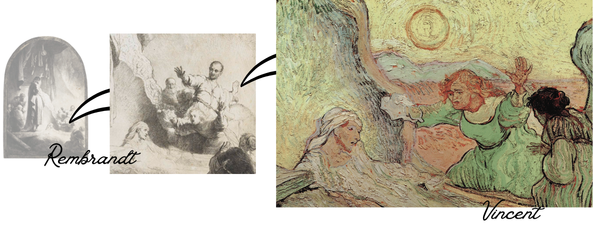
He painted it in 1890 while in an asylum in France. He had just completed his more popular Starry Night. The Raising of Lazarus is based on part of this etching from Rembrandt:
Vincent was extraordinarily perceptive, and because of that he suffered greatly. He was a man of sorrows, acquainted with grief, and burdened with being able to see what most men could not, and how great was his anguish because of that.
His life was a series of spiritual resuscitations, each resembling the raising of Lazarus, because, while Vincent died many times, the Lord raised him up just as often through the intercession of his brother, Theo, who would die just 6 months after Vincent, at age 33.
Looking at his depiction of Lazarus, we see Vincent’s given him a beard like his own. We see the sibling intercession for which he was so grateful, symbolized in Martha and Mary. But why did he remove the figure of Jesus from his version of the scene? And where is his brother?
Our Lord and Vincent’s brother, Theodore, whose name means “gift of God,” seem both to be depicted as one in the sun, whose light fills the tomb of Lazarus, lifting him up. “If you knew the Gift of God,” Jesus said to the woman at the well. Vincent knew Our Lord, the Gift of God, in his brother, Theo.
Although I had no formed opinions about Van Gogh’s alleged suicide when I was a teenager in 1996, I have since come to be of the opinion that he did not take his own life. I think he was shot by Rene Secretan, the 16 year-old who was unwell, and who had been antagonizing Vincent in the fields for painting the light that others could not see.
The friend of mine with whom I visited Amsterdam did despair of life. I said his funeral Mass a few years ago. We fell out of touch well before that. I sometimes wonder if things might have turned out differently for him had I stayed as close to him as Theo did to Vincent.
Vincent died in 1890, the same year he painted The Raising of Lazarus. His own name means, “one who prevails,” and that’s what I prefer to think of his death, because to the end he was accompanied by the light and warmth of his brother, Theo, who wept for him as Christ wept for Lazarus. +